 |
RECONSTRUCTING THE WARRIORS OF THE BRONZE
AGE WEAPONS
5/24/17 |
 |
* Main Bronze Age Page * Armor * Weapons * Chronology * ROMULUS *
close-up of the hilt, too. The grips and pommel were cut from the same block of walnut, by the way! No idea why they aren't the same color. This photo shows the parts unassembled, with the wooden pieces carved out to fit into the hilt recess. That was some tedious woodworking, using mostly my Dremel tool to fit the pommel but only knife and files on the grips. Bronze "boat nails" serve as rivets, with a piece of brass rod to hold the pommel since the nails weren't quite long enough.


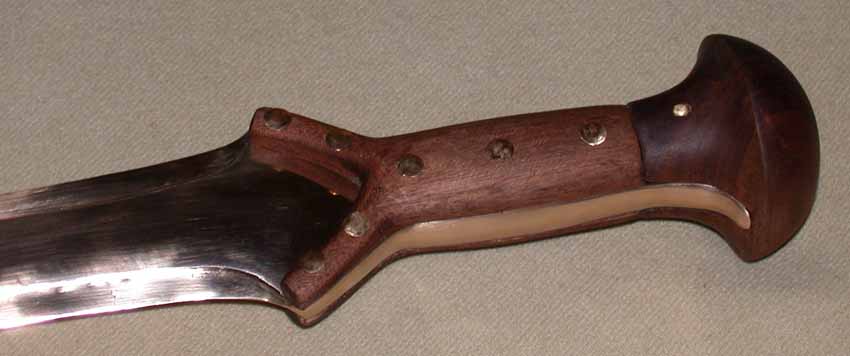

I am very curious to find out just how accurate this all
might be! My guess is that the whole hilt area was
smaller and narrower, and the pommel may have been a
different shape and secured in a different way. But
this feels good in the hand. Finished weight, 2 lbs. 2
ozs. Blade length from the tips of the guard is
22-1/4", maximum blade width is 1-9/16". Overall
length 27-3/4".
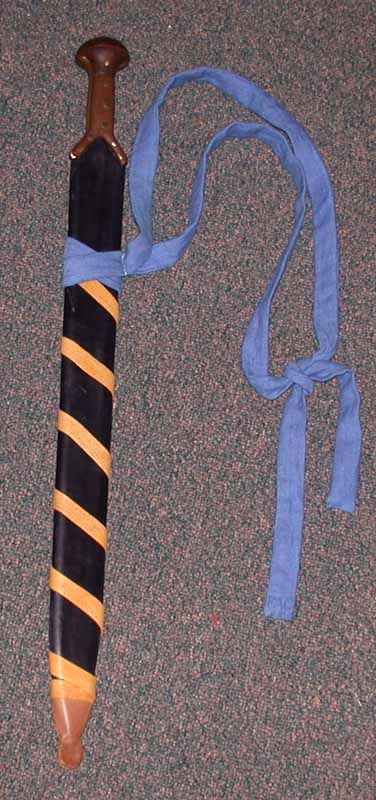 |
The scabbard is wood covered with leather. The spiral band and chape based on a scabbard shown on an ivory mirror handle from Cyprus. I used leather for the chape because I do not know of any surviving bronze ones (for this sort of sword), and because I wasn't sure I could make a nice one! The baldric is folded linen, and ends tie at the shoulder as shown in the Pylos fresco. |
 |
Here
is Neil Burridge's Naue
type II, based on an original from Crete,
shown next to my Del Tin sword. You can see how
Neil's is much finer and smaller overall--much more
accurate! A much better alloy, too. He
even hardened the edge for me. All I have done
so far is clean it up and carve a little metal out of
the inside of the hilt area. |
 |
The
Del Tin really feels like a monster by
comparison! I'm tempted to take the belt
sander to its blade again... I plan to get
olive wood for the hilt on the new sword. |
 |
Complete! Olive wood is a little hard to work with, but polishes up very nicely and looks great! This sword is my best-feeling bronze one yet, light and well-balanced. Here is a close-up of the hilts. The pommel is held on by friction and a little hide glue. 3/22/06 |

To learn sword-making from
the master himself, see Neil Burridge's page on his annual Bronze
Sword Festival, http://www.bronze-age-craft.com/Bronze-Sword-Festival.htm, or buy his swords here: http://www.bronze-age-craft.com/swords_for_sale.htm
 |
I promised Neil Burridge that I'd do a nice job finishing and hilting this sword that he cast, and post photos and links to his site. Glad to do it! It's a British sword, the Ewart Park style. It is a VERY nice casting, very clean with a lovely midrib. Blade length is about 19", maximum blade width 1-15/16". Jeroen Zuiderwijk has been working on an identical sword, and says the blade should not thicken at the widest part, and that the maximum weight should be about 750 grams. Mine is 2 lbs 3 ozs (992 g), so there's a little grinding to do, but it will be much easier than on the Del Tin sword! |
 |
Close-up of the
midrib. You can see that it fades into a very
subtle raised area where blade meets hilt. These
first two photos were taken on August 7, 2004, two
days after the sword arrived in the mail. Now
for some shop work! |
 |
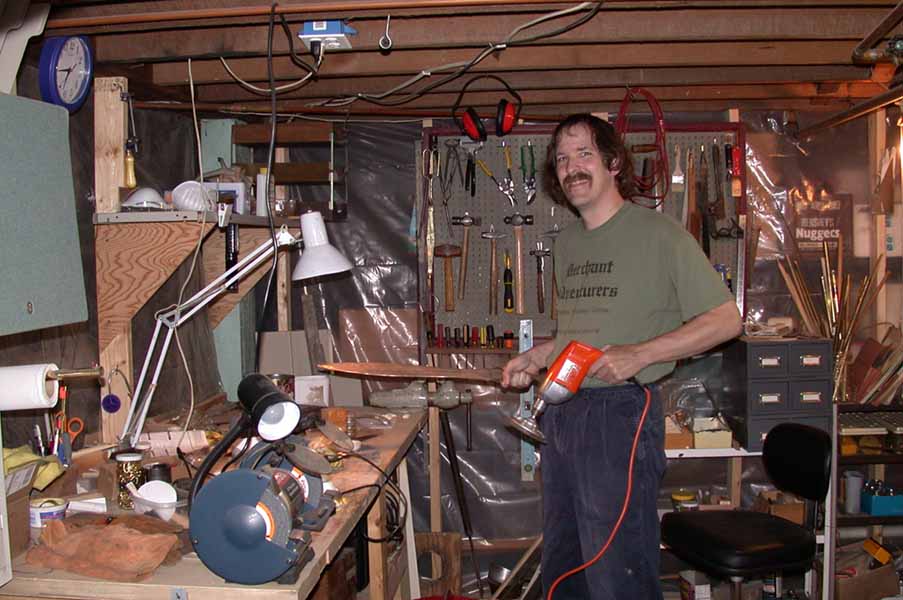
On August 29 and 30 I finally did about 5 hours of grinding and sanding, but only took off about 3 ounces. So far I've only been grinding between the midrib and the point, though I cleaned up the rest. But that's not enough, obviously. Remember, kids, grinding makes the metal very hot! |
| See above--doesn't look much different! | September 22--After a couple more hours of work with grinder, flap sander, sanding disc, and Dremel tool, the weight is still 2 pounds. Geez, I thought I'd made a little more progress than that! I have realized that this bronze is considerably harder than the alloys that I've worked on before. So I'll have to get meaner! |
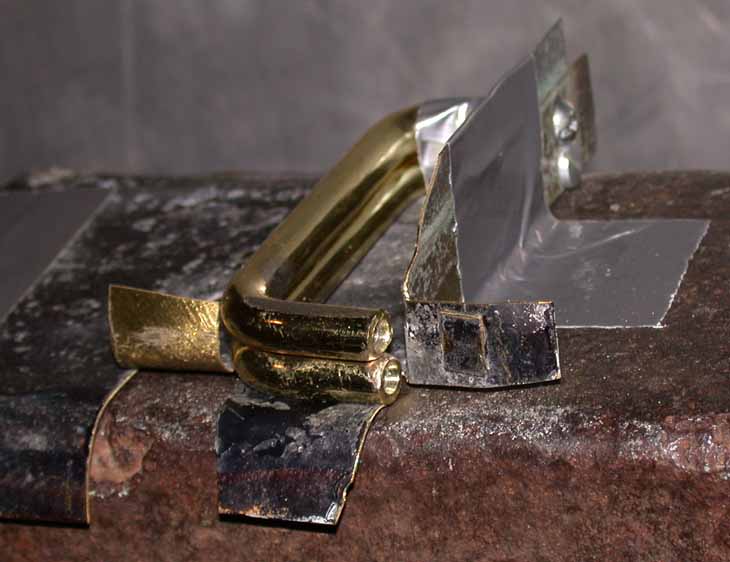 |
September 26--One last grinding session, then sanding with coarse, fine, and extra-fine sandpaper, followed by Scotch-brite pot-scrubber pad on the sanding disc. Only the buffing to go. Got it down to 1 lb 14 oz, or 850 g. Here is my edge-hardening jig, two old brass door handles attached to a scrap of sheet brass by the pair of screws at the far end, all taped to my old anvil. |
 |
Edge-hardening jig in action. The tabs on the sheet brass serve as guides to keep the "hammer and anvil" striking at the same distance from the edge at all times. No steel touches the blade, and in theory this will make a uniform bevel right along the edge, while hardening it. Well, in theory... |

 |
After a long pause
to find a decent bone, the hilt is coming along.
January 24, 2005, the bone handle is riveted in
place. Crappy job, my holes got crooked, the
pieces are slightly askew on the tang, and I DROPPED
one just after getting the holes drilled and broke
it! Glued it, seems to work. You can see
the line, second rivet from the left. The oak
pommel will fit over the tabs at the end, and the
bronze dome will cover that. Hopefully.
Just a little more carving to fit the pommel in place,
polish the dome, and hammer it's edges down around the
edge of the wood pommel to hold it.
Hopefully. The rivets Neil sent are leaded
bronze and work wonderfully, but next time I'll use
narrower ones. |
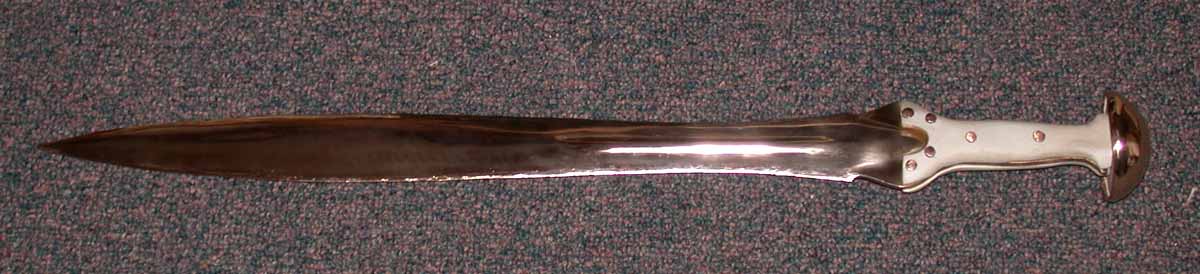 |
January 28, the sword is complete. The pommel seems to have worked well, and it certainly is shiny. Consider me happy! I also did a little more edge-hammering, using just a cross-peen hammer on the anvil, followed by a little filing to clean it up. |
 |
A close-up of the hilt, showing the underside of the pommel. There is also a view from the side of the hilt, and one from the end. Thank You, Neil! It's been a pleasure working on this. |
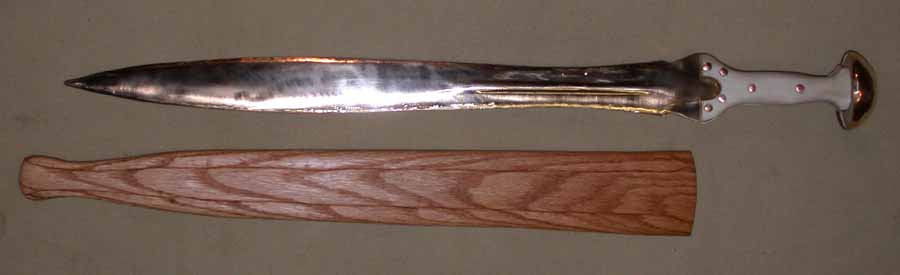 |
January 30, the scabbard is done, too. It is made of oak and based on the one from Barde Store Hoj, Denmark. The inside is lined with linen to prevent the blade from rattling, and to keep the oak from making green marks on the metal! |


Order your fabulous Neil Burridge
sword today! http://www.bronze-age-craft.com/swords_for_sale.htm
 |
Another excellent blade from
Neil! This one is a "rapier", generally believed to be
more for thrusting than slashing since there is no
tang. The date is around 1300 BC. 17-1/4"
long, weighs 11 ounces. |
 |
An evening's work. The blade is shined up, though I have left a little minor pitting and uneveness. The blade is already thin enough and the midrib subtle enough that I don't want to take off too much metal. The hilt has been cut and roughly rasped to shape--I think it's maple. |
 |
Memorial Day, 2005, and it's finished. Carving out the groove to a snug fit was dicey. I kept routing out tiny bits of wood until the blade could be pushed almost all the way into the slot, then rapped it tightly in. Almost didn't need rivets! |
 |
The wood is coated with linseed oil. Overall length, 20-5/8". The grip is very short but feels quite good in my hand, and the weight is like a steak knife. |
 |
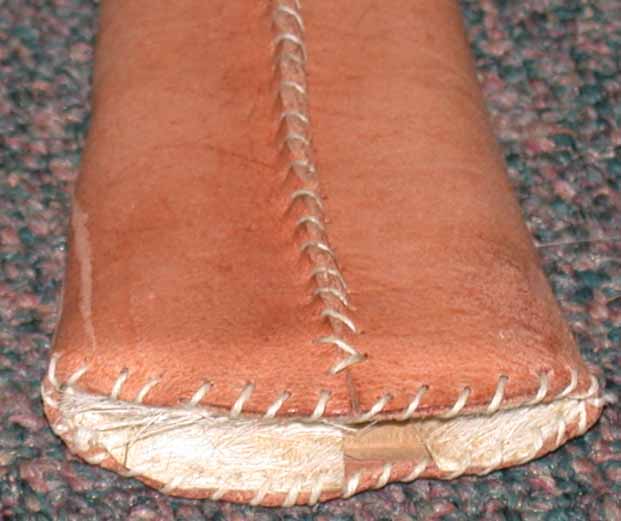
The scabbard is quite plain. The blade is wrapped with hair-on goat hide, which is sandwiched between two shaped pieces of thin wood, then a leather outer covering. The leather and hide are sewn together at the mouth, as shown here, to keep the blade from getting between the layers. |
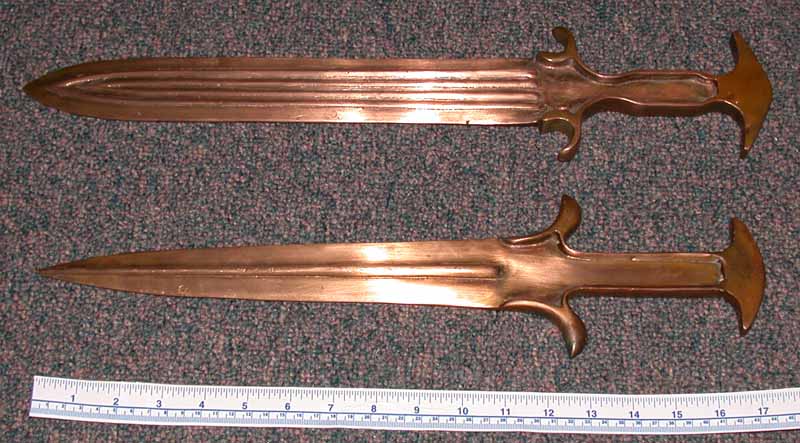 |
January
2006. These are the two Type G Mycenaean
swords from Albion Swords, made by International
Steelcrafts in India. They name the top one
the "Odysseus" and the pointed one the "Achilles",
while I'm starting to think of them as "Beater" and
"Biter". They were given to me by Steve
Peffley, who did the lovely wooden models for them,
only to find that the Indians had thickened them
into (as he aptly says) "boat anchors". |
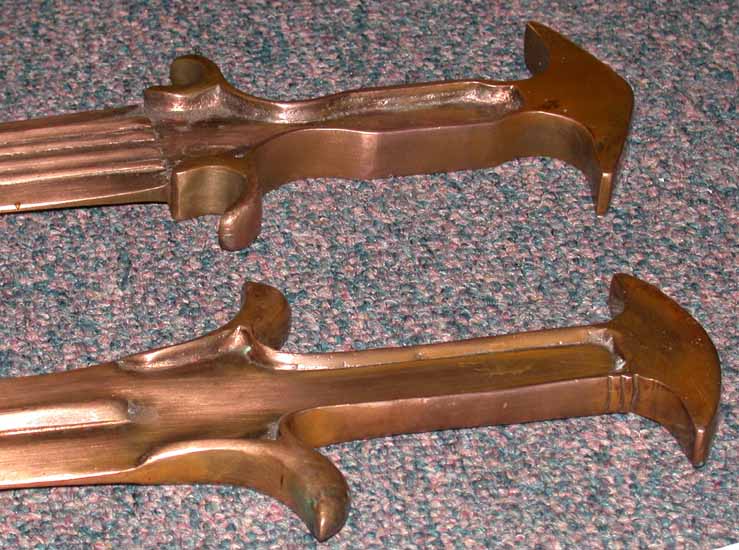 |
Closer
view of the hilts. The pommel area should be
hollow like the rest of the hilt. On the
originals, the guards were flanged as well, and the
flanges hammered in to meet, so they were hollow
inside. These are solid cast, of
course. Note that these swords are
bronze, while more recent castings are apparently
copper. |
 |
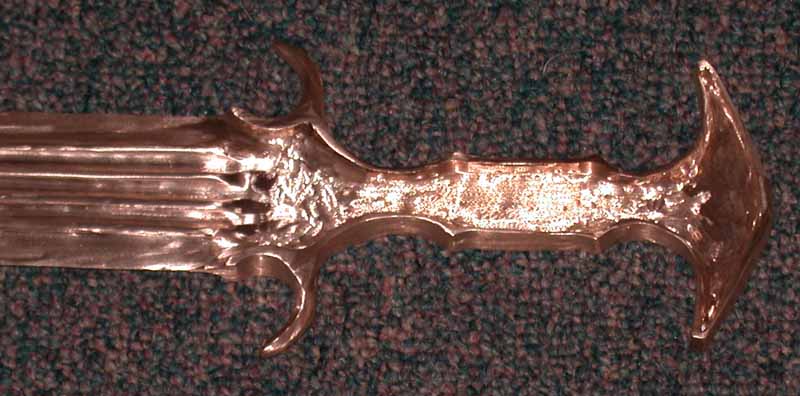
Work
in progress. I did not have a chance to
weigh the swords before grinding, but have been
weighing the dust and shavings that I grind off of
them (having a small postal scale for that). I spent about 4 evenings on
the pointed one, with grinder, drill, Dremel, and
belt sander, and removed over 9 ounces of
metal. I even drilled into the guards to
remove a little weight. About 3-1/4 hours on
the wide sword has removed 9-1/2 ounces. Still
need to smooth out inside the hilt area, and do more
blade work. |
 |
A few more days of noise and dust, and it's pretty much done. The shape of the grip is more refined, the guards trimmed down, the pommel hollowed, and MUCH work has been done on the blade. Total of metal removed, 18 ounces! And the current weight is 1 pound 8-1/2 ounces. A boat anchor no more. |
 |
The hilt for the pointy sword will be ash. One grip is about done, and the pommel is coming along. The other two roughed-out pieces are also shown. Current weight for this sword is 1 pound 5 ounces. The wide sword will have a cherry hilt. |
 |
First one done! The wood came out with an interesting two-tone effect, different on both sides. The single long rivet which holds the pommel pieces in place is very difficult to peen, being on such a steep "slope". Finished weight is 1 pound, 6 ounces. |
 |
2/22/06--Finished the second one, with cherry for the hilt. It is clear from surviving organic bits, and from rivet lengths on other swords, that the pommel halves were often flat like the grip, so I went with that for variety's sake. (Not just laziness!) The final weight is 1 pound, 10 ounces. |
 |
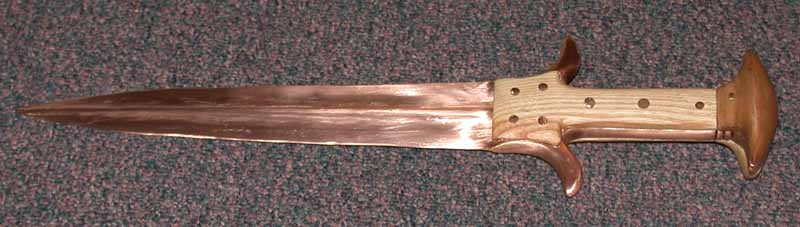
Another
very fine Naue II by Neil
Burridge, 1/16/07. Take particular
note of the excellent job of edge-hardening!
What looks like a machined hollow-ground edge has
been hammered in. Overall length 24-1/2
inches. |
 |
Close-up
of the hilt. The rounded ridge between the
flanges is there to allow the molten metal into
the mold, and will be ground away before hilting. |
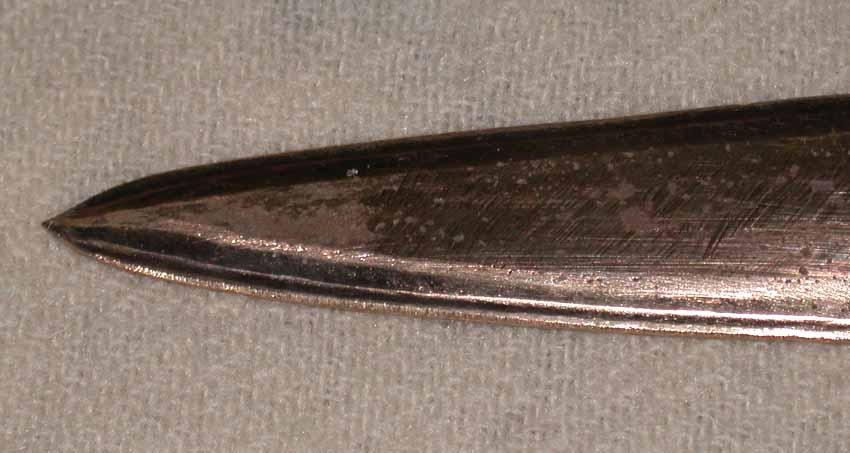 |
The
tip, showing the geometry of the hardened
edge. Neil has a special tool he uses for
this. |
 |
Close-up
of the edge--the hammer-marks are visible.
The surface has only been partially finished! |
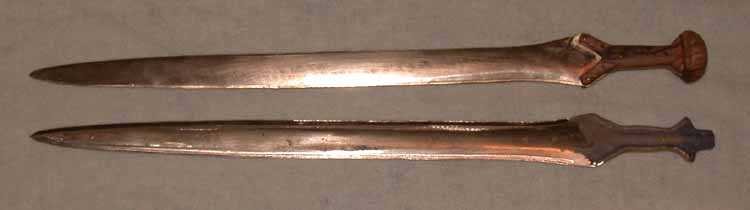 |
The
new blade shown with my other Neil
Burridge
Naue II. Very similar in size, but not from
the same mold. |
 |
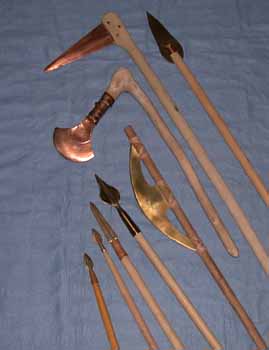
The latest lovely pieces from Neil, April 2007. The basal loop spearhead is at left, and next to it his excellent socketed axe. The latter is hafted with yew. The Urnfield blade at center still needs to be cleaned up and hilted. The sword at right is his Witham antenna-hilt, but doesn't have its antennas yet--see below for the finished swords. But the scabbard is done, painted and waxed linen over wood, with 2 bronze rings held on by leather strips, and the baldric ends slit and braided through the rings. |
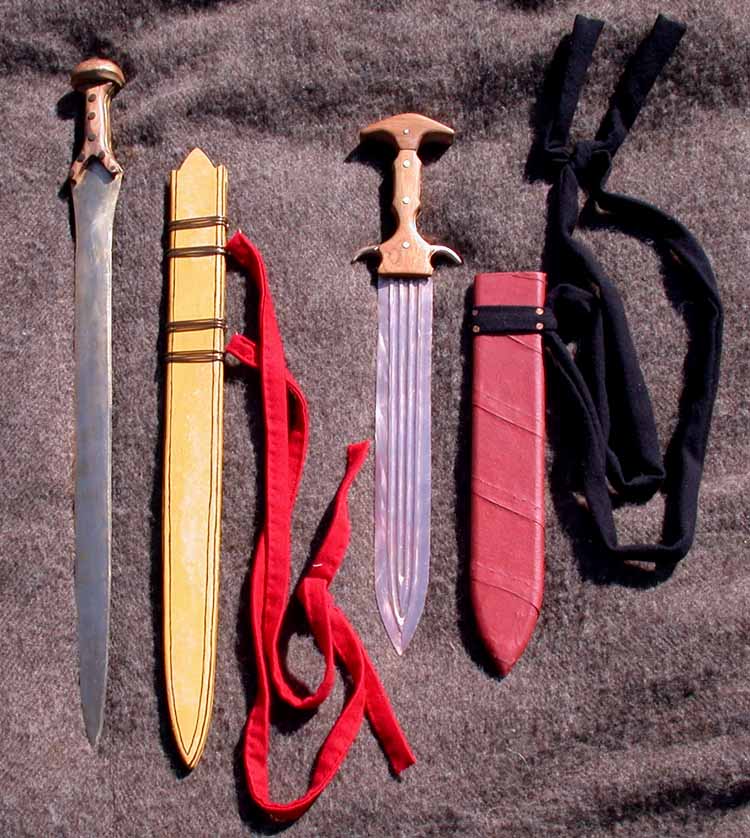 |
Two
of my Mycenaean swords with their scabbards.
My Neil
Burridge
Naue II is at left; its scabbard is painted wood
with bronze wire forming loops for the
baldric. At right is my Albion type G, with
a linen-covered wood scabbard. Both baldrics
are folded wool strips, tied at the
shoulder. 4/20/07 |
 |
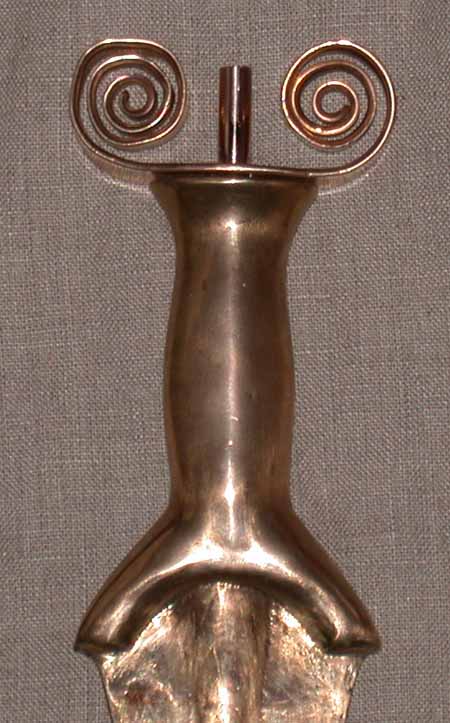
Completed Urnfield sword. This type generally had a cast bronze hilt, but that being a little beyond my capabilities and budget, I went with a single piece of yew wood. Here's a close-up of the hilt. |

 |
Finished
Antenna Hilt. Many of these were cast in one
piece, while other types were applied in a couple
different ways. I opted for cutting the
antennae out of thick sheet and pegging that to
the pommel with a piece of rod. Curling them
up was tricky! One end
got kinky, and I had to uncurl it, smooth
out some tool marks, re-anneal, re-polish, and
re-curl. Here is a
shot from the end. I use this sword
with my Villanovan
impression. |


 |
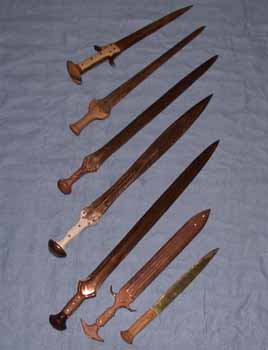
These
three lovely blades by Neil
Burridge have been languishing unfinished
for far too long. Top is a Type Ci rapier
that I got from Gregory Liebau. I MUST make
a stone pommel for it! Middle is a Type G
sword which will get an ebony hilt, bottom a Type
B dagger. |
|
I ended up going with
bone for this hilt, being inspired by a SWEET
little Type G in the "Agamemnon to Alexander" show
at the National Geographic in 2016. The
scabbard is covered with linen, with wool spiral
wrap and white leather chape and throat (mostly
for simplicity's sake!). The baldric is hand-woven
wool. March 2017. |
 |
 |
 |
 |
These three small
bronze points are from Native Way. The
large one at left is only about 6" long including the
tang, which has a right-angled tip typical for c. 2000
BC. The other two points are about 3" long, the
right-hand one having a straight tang. So they
are javelins rather than spears or arrows. I
bought them rough-cast (nice and cheap!) and cleaned
them up a bit. The largest shaft is about 7/8"
diameter by 5 feet long, plus the head and buttspike
for a total length of 69". The smaller
javelins are about 50" long; that on the right is 5/8"
diameter, while the center one is 3/4" thick in the
middle but tapered towards both ends. |
Looking for arrowheads? http://www.bronze-age-swords.com/aegean_swords.htm, bottom of the page.
 |
Yes!
Good spears! From Neil
Burridge, of course. The top one is his
Irish "basal loop" spearhead, so called because of the
two slots or holes at the base of the blade. We
don't know if they had any function! The head is
14" long, and the shaft is about an inch in diameter,
a brush handle from Torrington Brush Company. Total length is
6'9". The smaller head is just over 5" long but
has a much wider socket. I stuck it on a piece
of pine closet pole for the moment, total length
5'1". Both heads are secured by hide glue and a
wooden peg. |
 |
Two
close-ups of the basal loop head before cleaning,
giving a good idea of the cross-section. The
loops have not yet been opened. |
 |
 |
Excellent
spearhead from Chris
Levatino in New York. I polished it up and
mounted it on a Torrington brush handle, secured with
a wooden peg. For a buttspike
I used a brass flagpole butt, which I will replace
when I get a better bronze one. June 2009. |

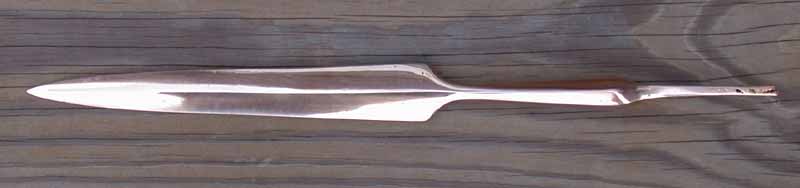
Here's
a lovely spearhead:
http://www.metmuseum.org/toah/ho/03/euw/hod_1998.540.1.htm
 |
Mike
Kasner was kind enough to send me this reproduction of
a javelin head from Ur, c. 2500 BC, just under 13"
long. It is gorgeous! Neil Burridge
is currently offering a copy of it, http://www.bronze-age-swords.com/Egyptian_and%20_Near_East.htm
|
 |
Another
Albion "boat anchor" from Steve. I must be mad
for throwing myself at these things! Just a
sucker for free toys, I guess, and can't stand NOT
doing anything to improve them! Starting weight,
2-1/4 pounds! Well, it should be easier than
those type G swords. Here's a side view, showing the
thickness. |
 |
The handle in progress, shown along with two other potential handles from the same tree (a neighbor's maple). The angle is a little more acute than I'd like, but we'll see how it goes. Removing the bark was very easy. |
 |
Grinding. Lots of progress, and it begins to feel like a usable axehead. Getting in between the flanges is a PAIN. |
 |
Okay, let's call it an axe! 9/21/06 Didn't bother cleaning up the part that will be covered by the haft. I hammered the edge before the final sanding to harden it, though I have not ground it sharp as yet. |

 |
9/23/06,
all mounted and done. Hide glue and rawhide fix
the head to the haft. The handle is kind of
crooked, and the whole thing feels kind of heavy and
clunky. Not a brilliant piece of work, but it
gets the point across (or the edge, as the case may
be!). |
 |
An
Egyptian
or Mesopotamian "epsilon" axe made from a piece of
thick brass sheet (c. 1/8"), copied from one in the
Axel Guttman collection. The head is 14" long,
and the overall length is 38-1/2". Easy and
cheap! |
 |
This
fearsome weapon is just over 13" long,
overall. Okay, it's more like a tool, good
for whittling spear shafts. The head is 5-1/4"
long and came from Native Way--smaller than I'd
expected! Seems to be decent bronze, though, and
I hammer-hardened the edge a little before sharpening
it. The
handle is ash. I enlarged the socket a little,
but it's still less than half an inch in diameter so
it's not going to stand up to combat. |
 |
This is an original bronze axehead owned by my father, Richard Amt. It is reportedly from Luristan, and would date to about 2200 BC at a guess. It was given to him by his brother Martin, formerly with the Freer Gallery of Art in Washington, DC, and came to him from a curator at a museum somewhere in the Middle East. The inner diameter of the socket is about 5/8" (16mm), and the outer diameter about 13/16" (21mm). There is a slight horizontal flange at the top, measuring 1-1/8" across (28mm) at its widest. |
 |
The
knife from the Dendra panoply tomb, made from 3/32"
scrap brass with an ash handle. I wasn't
planning on a pommel at first, but the original has a
tab on the end which was clearly for attaching a
pommel to swords and other knives. Total length
14-1/4", blade 10". |
 |
This
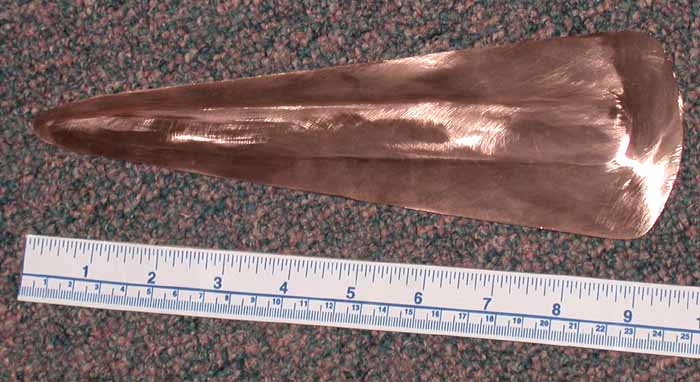
is "Cast Bronze Dagger Blade #3" from Albion Armorer's
"Moat Sale"--got it for my birthday. I'm not
sure just which dagger it is supposed to represent,
but it probably should not have a tang. Total
length about 13-1/4", starting weight 1 pound, 12
ounces! Oh, and it seems to be pretty much
straight copper. I am going to make it into an
Early Bronze Age "halberd". (Photo swiped from
the Albion site!) |
 |
Lop
off the tang and start grinding. The copper is
soft and work goes pretty quickly. About 4 hours
of work cuts the weight in half, to 14 ounces.
Length is now 9-5/8", maximum width 2-7/8". |
 |
December 21, 2005. Shortened the midrib a
little, then realized the overall dimensions were
within a few millimeters of the halberd from Carn,
Ireland. So I rounded the shoulders to
match. I also hammer-hardened the edges, sharpened them
with a file, and hit it with the sanding disc
again to clean up the mess I made. Weight is now
just under 13 ounces. The Carn halberd has an
intact oak handle, shown in progress. Had to use
ash, though, since my nice oak stake turned out to be
cedar... |
 |
December 22, finished! Routed out the groove
with drill and Dremel, and dribbled in my last bit of
hide glue before riveting. Like the original,
the handle is about 40 inches long (1 meter)!
Finished weight is 1-3/4 pounds. It's a
pretty scary weapon. |
|
|
Looking for arrowheads? http://www.bronze-age-swords.com/aegean_swords.htm, bottom of the page.