WEAPONS
DORY - XIPHOS - KOPIS
5/13/17
|
|
WEAPONS DORY - XIPHOS - KOPIS 5/13/17 |
|
| Hoplite Home Page |
Clothing | Helmets | Photos | Other Greeks,
and Others |
| Shield--Aspis/Hoplon | Armor | Weapons |
Bibliography | The BRONZE AGE |
 |
Tom Kolb's spearhead is one of the best I've seen, from Manning Imperial. Just under 10" long, and the socket is about 7/8" diameter. Very light and nicely shaped. |
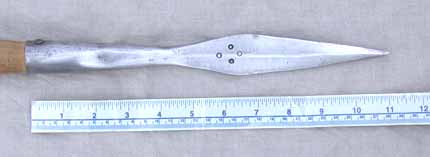 |
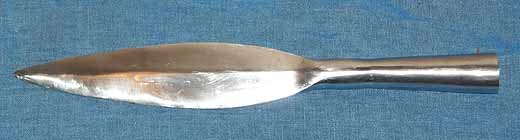
My "alpha" spearhead is 11" long overall, and
was hand-forged long ago by a fellow named Brock. The
4 little circles are his maker's mark, but some toy company
copied them onto their Greek hoplite action figure's spear! |
 |
My "beta" spearhead is ground down from an
old Museum Replicas "Large Spearhead", originally a
triangular 19-inch monster. I lopped 3" off the socket
and 4" off the blade, so now it's under a foot long and
looking quite nice. I thinned the blade some, and
reduced the ugly weld lump where the blade met the socket. |
 |
The BEST commercially available off-the-shelf spearhead is the "Small Spearhead" from Kult of Athena, item number 1823092900, http://www.kultofathena.com/product.asp?item=1823092900 . I bought 2. They are 9" long and weigh 8 ounces apiece, with a c. 1" socket. The socket is split, and you can see traces of the hand-forging process between socket and blade. Excellent price, too! |
 |
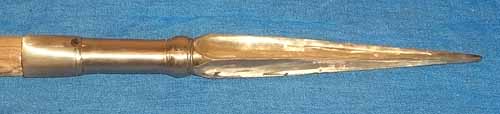
Go
hand-forged if you can! The shorter of these was made
by Mark Morrow, though I ground the midrib into it.
Length is 8-1/2 inches. The longer one, about 12", was
forged by my nephew from a piece of sword blade leftover
from my first short xiphos conversion project. Both
have split sockets, and *could* be a little more nicely
finished, but I decided not to mess with them any
further. The are on lightweight shafts about 3/4"
thick, without buttspikes, and serve as throwing spears
(longche in Greek). Their overall lengths are a little
over six and a half feet. |
 |
My first buttspike is a "first generation" from Manning Imperial, which I found to be heavier than I wanted (though very nicely cast!). After some grinding, it weighs about 1-1/2 pounds, a good weight, and is c. 13" long. Manning now does some VERY nice sauroters, http://www.manningimperial.com/item.php?item_id=619&g_id=1&c_id=14 |
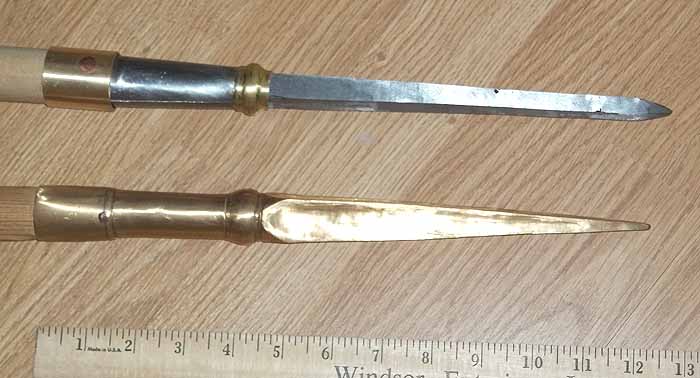
| So here is my first attempt at an iron
sauroter! The spike itself is narrower at the top than
I wanted, but it was what I had on hand. The iron part
of the socket is just scrap steel sheet wrapped into a
tube. I am not sure that any nail was used on the
originals, but in this case it goes through the brass band,
the iron tube, and the tang of the spike itself, to hold
everything firmly in place. The brass joint ring is
soldered to the iron tube. |
 |
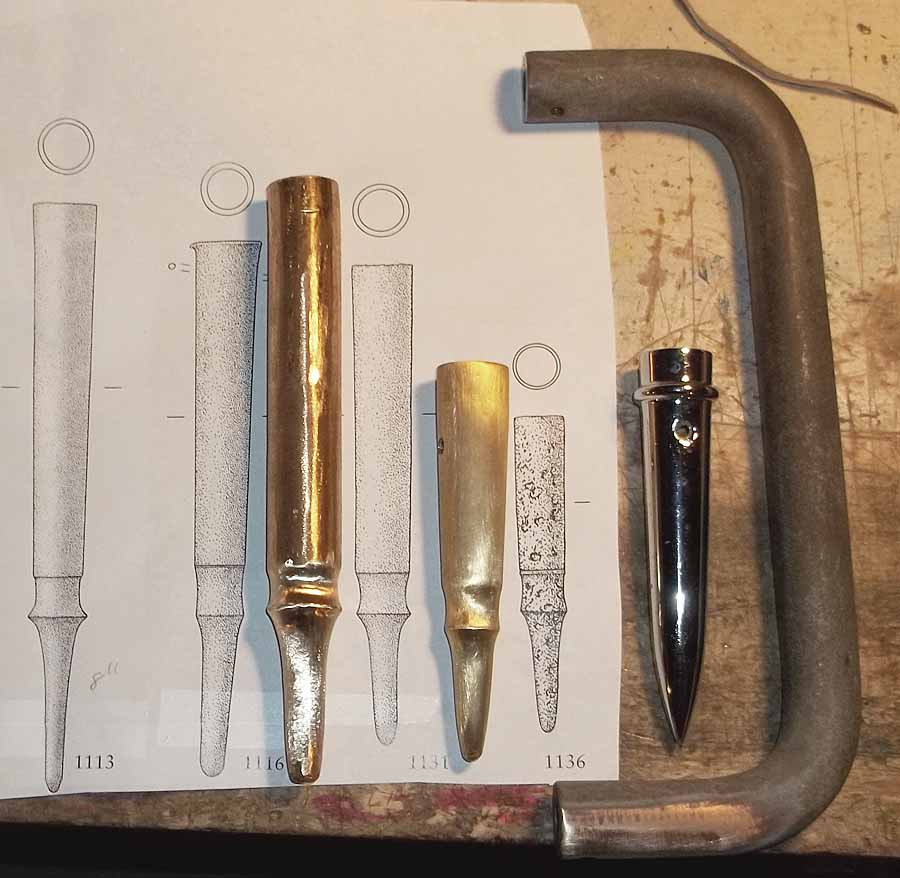 |
Also found at Olympia were
a number of tubular sauroters, mostly bronze but at least
one made of iron. The smaller one was very easy to
grind out of a modern chrome-plated brass flagpole
buttspike! But it's not heavy enough to serve as a
counterweight. The larger one started as a door
handle, 1" diameter solid bronze (an unused one shown at
right). Grinding the outside to shape was no problem,
but lacking a 3/4" drill bit suitable for metal I had to try
boring the socket out with a series of smaller bits,
breaking a half-dozen in the process and dulling several
more. (So that other door handle can darn well stay a
door handle for now!) But now it's a nice 1-pound
sauroter. |
| This
sauroter I built from some sort of bronze socket thingy
mated to a ground-down piece of round-section door
handle. It's also based on an example from Olympia,
though again most have longer sockets than this one.
This one I use on the upper section of my Macedonian sarissa
to convert it to a handy 8-foot spear when needed. So
the socket inner diameter is 1-1/8" and the pin is
removable. |
 |
 |
| The
blade of the hoplite's sword (xiphos or machaira)
is described as "leaf-shaped", and varied in length.
The best-known examples are roughly two feet long, but many
originals are shorter. The blade was iron (not
bronze!), and sometimes had a midrib, but many were plainer
with a lenticular or flattened diamond cross-section.
It seems that midribs predate the other options, but I don't
know for certain when blades without ribs first
appeared. Though the blade is usually shown as fairly
broad, much narrower ones are known. I suspect that
many modern reproductions are too large! Those who
have been fortunate enough to handle original Greek swords
always remark on how small they are, thin and light. NOTE: Much popular information on Greek swords comes from Peter Connolly's "Greece and Rome at War." However, all the archeological examples he shows are from ITALY, and construction methods tend to be different from the Greek examples. Overlying hilt plates of iron or brass are not common in Greece, and again may be a more northern fashion (Macedonia and Thrace). |
 |
The tang
of the Greek sword basically matches the outline of the
hilt. Some examples have a flange along both sides of
the grip area, but on others the tang is simply flat.
The tang area was quite thin, around 2mm, abruptly
thickening at the base of the blade. There are NO
rod tangs (such as Roman or medieval swords typically
have). Richard Hook's reconstruction of the xiphos in
Nick Sekunda's Osprey book shows a rod tang, but that is
incorrect. The grip is made of wood or bone or ivory in a "scale" or "slab" construction, with a shaped plate applied to either face and riveted through the tang. The guard and pommel *could* be made in the same way, but could be done in other ways (below). The blade at left was made by Dave Akers, and he kindly permitted the use of his photograph. |
 |
The tang
can match the entire outline of the guard, flaring out to as
much as 4-1/2" wide, with pointed ends. In this case
the actual guard is applied by scale construction like the
grip, and can be wood, bone, ivory, iron, or possibly
bronze. I call this option the "full-width guard tang"
(snappy, eh?), and it was used from at least the 6th century
BC to the late 4th. Alternatively, the tang can flare out into stubbier "shoulders", as with the right-hand example, with the guard itself projecting beyond. In this case the guard is *apparently* a single solid block, iron or possibly organic, with a slot cut through to slide down over the grip tang and rest on the shoulders. The bottom is grooved so the top half of the shoulders are actually recessed into the guard. There is some doubt that the shorter shoulders with a one-piece guard actually existed. The shoulders were hammered out quite thin, and it's possible that they have corroded away in some cases, leaving the stubs. The few drawings of what look like one-piece guards still in place could also be in error due to corrosion, etc. So the full-width guard tang with scale construction guard is the best-documented option. Certainly a one-piece guard can be considered for improving a less accurate reproduction sword with a rod tang that needs to be rehilted. |
 |
The
bottom edge of the guard is straight, never curved,
with an optional semicircular or U-shaped notch in the
center. The top edge tapers or curves downward at each
end, and the top itself is rounded off to a semi-circular
cross-section. It is not thick or bulky in any
way. It also seems that there is often a gap in the
middle between the guard itself and the tang or blade, so
that a tab or extension on the bottom of the grip scale
slides under the guard, secured by 2 (or more?)
rivets. In other words, the two ends of the guard are
connected by a "bridge" in the middle which passes over the
bottom of the guard. The profile of the upper edge of the guard can be quite elegant. It can be "double-tapered" like C at left, with a "valley" near the grip then rising and tapering off again near the tip. Or it can simply taper down from the grip as with example A. Type D and E have a "saddle" in the middle. On several Macedonian examples, the center spike on E was decorated as an acanthus leaf or even a scorpion. Iron guards and guard plates can be flush-riveted, so that the surface is smooth. Normal rivet heads (rather than flush-riveted) seem to be smallish and rounded. Also note that rivets near the ends of a wooden scale guard plate can cause the wood to split! At least a couple guards are known that have a gold or other thin metal sheathing over wood or ivory parts. This may be a Macedonian fashion, however--the best example is from Phillip II's tomb at Vergina. Example F, below, is my interpretation of a xiphos guard from Macedonia, 6th century BC. It is shown in the Aigai ebook linked below, on page 159. It is metal and may be hollow (over an organic core).  http://www.latsis-foundation.org/megazine/publish/ebook.php?book=75&preloader=1 |
 |
Xiphos
guard reconstruction by Dave Akers, viewed from the
blade. The "bridge" where the bottom of the grip will
be inserted is clearly visible. |
 |
The
pommel is not completely understood. On some swords
the tang ends in a rectangular or squarish section which the
grip section neatly flairs into--B at left. This can
have a rivet through it (often close to the grip), so the
pommel was apparently made by scale construction as well,
two halves riveted through the tang. The height of
this pommel tang tab can be as little as 3/8" such as on
example C, to an inch or so. There are original
depictions of pommels that are small discs, which would
perfectly fit on a short tab. Conceivably, such a
small pommel could be made as part of the grip, each scale
simply expanding to a half-disc. On other swords, there is a short rod tang or spike at the top of the grip, clearly for securing a solid pommel. The tang would project completely through the pommel and be peened (flattened) like a rivet over a washer or metal cap. This is actually visible in some vase paintings. The widened base of the spike shown on A at left is to allow for a rivet hole, but it will also prevent the pommel from rotating. Pommel tabs like B and C definitely date back into the 6th century BC and may have been used for centuries. Pommel spikes are seen on 4th century artifacts, but are also suggested by vase paintings from c. 500 BC. |
 |
My
reproduction based on a xiphos from a grave at Vitsa, #418
in Kilian-Dirlmeier. Here is the blade cut from 1/4"
thick steel scrap (using an angle grinder), mostly ground to
shape. I found that the 40-grit flap sander was the
best tool for removing metal quickly and with good
control. Final sanding and polishing has not been
done. The blade has a lenticular cross-section, and is
16 inches from point to guard. The pommel section on
the original is missing, so I decided to go with a pommel
spike. (3/15/14) http://ancientreenacting.proboards.com/thread/689/new-xiphos |
 |
Hilt
parts from hardwood, though the original guard was iron and
the grip plates apparently bone. My pieces of bone
were not big enough, nor was I able to find a piece of steel
for the guard among the junk piles that pass for my
workshop. Wood was certainly used for some hilts,
since blades are found with rivets in place but no hilt
parts remaining. |
 |
Top view
of the guard, showing the "bridge" into which the bottom of
the guard plate will fit. |
 |
View of
the guard. I believe the ends should be narrower, but
I don't want to risk the thing breaking! |
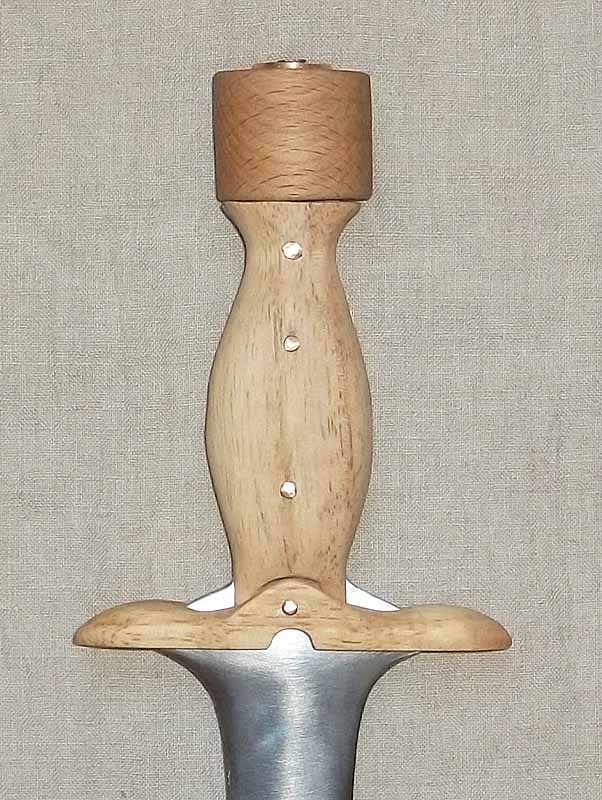   |
Hilt
assembled! The shoulders of the blade are visible,
projecting through the top of the guard. This is not
unique! At center you can see the bottom of the grip
plate under the guard bridge. The pommel spike is
peened over a bronze washer. The hilt rivets are made
from bronze boat nails, with the heads cut off and peened at
both ends. The wood is coated with linseed oil.
Final weight is 1-1/2 pounds. |
 |
Wooden
scabbard covered with blue linen, bone throat made in two
pieces, bone and steel chape. I call this style
of throat "winged"--this one is based on the Olympia
example, though others are visible in artwork. The
chape is based partly on the fragmentary iron and bone
remains found with this sword, and partly on a bone chape
from Philia. |
 |
Both of
these scabbards have a pair of metal rings attached by
leather thongs, making an X pattern on the front. The
baldrics show two different interpretations of the "ladder"
effect commonly seen in vase paintings. The upper is a
simple strip of leather with slots cut in it, leaving
"rungs" at regular intervals. The lower is 2 hemp
cords connected by bronze bands--in some depictions the
"rungs" do seem to be separate pieces of some sort. |
 |
 |
 |
Carving
out two pieces of bone that fit the scabbard, each other,
and the sword hilt is nearly impossible. There is also
practically no information about how the throat was attached
to the scabbard core, so I hollowed it out to fit over the
thinned-down wood. The one-piece ivory throat
from Olympia (#1338 in the scan
from Baitinger) has a slot that is wider in the
middle, so the scabbard wood was narrowed into a projecting
"tab" to fit that. (Naturally I completely missed that
little detail in building my first couple scabbards...) |
 |
 |
 |
The
chape is also hollowed out to fit on the wooden core.
While the Philia chape has an impossibly narrow slot, I
decided on a recess in the bone backed with the steel plate
to make the "slot". The steel is two pieces soldered
together, since my clever attempt to do it in one piece
ended in a very warped failure. The two rivets at top
center go through the scabbard wood. |
 |
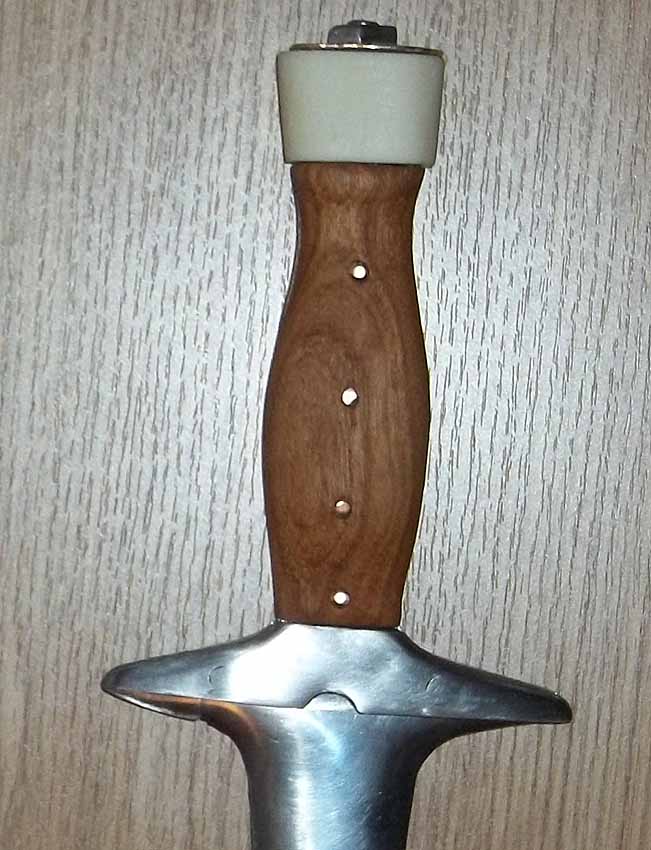
Rebuilding an older-generation Deepeeka xiphos. From a
starting weight of FOUR POUNDS, stripped off the hilt and
ground it down to match the shape of #425 from
Kilian-Dirlmeier. At right, the finished new
hilt. The steel guard is simple slab construction
without a bridge, with flush rivets, and the grip slabs are
cherry with bronze rivets. The pommel is bone, secured
with a bronze washer and a steel nut that the pommel spike
is peened over. The final weight is 1-1/2 pounds. |
 |
 |
Scabbard
construction. The wood core is covered with
leather. The top of the wood is trimmed down to a pair
of tabs which will project up into the throat, shown
rough-cut. (One of the tabs lost a corner, not a big
deal.) At right are the finished throat and chape,
made of olive wood. You can see the wider central part
of the slot through the throat, where the tabs of the
scabbard core will fit. The bottom of the core is
similarly trimmed to fit into the chape. Olive wood is
gorgeous, but always has cracks and flaws. |
 |
 |
Completed sword and scabbard. The baldric is hemp cord
(available online in several colors as bondage cord, believe
it or not!). The suspension rings are copper
washers. Each is knotted into the middle of a pair of
flat black leather laces, which are knotted on the opposite
(lower) edge. Then I wrapped linen thread around the
ends to make nice tassels, and used a curved awl to stitch
the laces to the leather covering (only across the
back). That will keep everything from sliding.
The baldric cord is simply doubled through the rings,
doubled over, glued, and wrapped with thread. |
 |
 |
Original
xiphos from the collection of the late John Piscopo.
The blade is about 20 inches long and obviously very
narrow! (And slightly bent!) The tang is broken
off at mid-grip--it's alarming how common that is. Note that the modern paper tag has been inserted under the "bridge" of the guard. The "saddle" in the middle is clearly visible, in this case rising not quite to a point. The U-notch is also visible. |
 |
At left,
my first sword and scabbard. I made it from an old
fantasy "medieval" blade, ground into the shape of the
Alfedena sword shown in Connolly (p. 103). It started
with a flattened diamond cross-section, and I ground the
faces to leave a midrib down the center. Since the
blade already had an incorrect rod tang, the hilt is just 2
blocks of wood drilled through, with a bone pommel. A
round brass nut secures everything--the "rivets" are just
small nail heads, for looks. Obviously the rod tang construction is NOT historical! It was simply the easiest option for a cheap conversion job. It looks okay from the front, but of course no tang edges are visible along the sides. So this old workhorse is just a "loaner", now! I also suspect that the "ladder-cut" leather baldric is not correct--a pair of cords is more likely. |
 |
 |
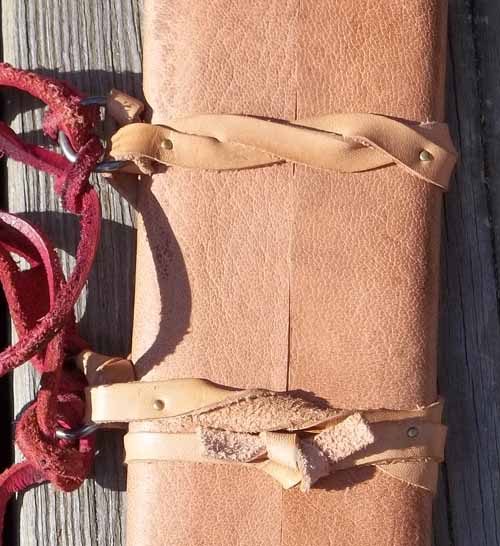 |
The
18-gauge bronze chape and throat based on the Olympia finds.
The throat is a little over an inch high. The chape is
a very common form in artwork, though was probably most
often wood or bone. On the back of the chape you can see
the nail which secures it--I decided not to put this in
front as the original piece has! The back of the suspension shows two steel rings held by crossed leather thong. Four small nails hold the thong in place. Some scabbards clearly show four rings, others only two. |
 |
The wood
and leather scabbard has a wooden throat based on the ivory
example from Olympia, and a plain chape of bronze
sheet. The suspension is simple leather thong tied on
to hold two rings, with glue and a couple small nails at
back to secure everything. The baldric is a narrow
leather strap--might have been an old dog leash! At far right, "Shorty" is shown with the two other items that were all made from the same sword blade: a spearhead forged to shape by my nephew, and a small knife I made from the leftover tip. Waste not! |
 |
 |
 |
My rough
sketch of a short xiphos based on two examples from
Olympia. The blade is about 12 inches long by a mere
1-1/8 inches wide! The blade flairs to about 2 inches
at the hilt. Three other sword fragments from Olympia
seem to be in this size range, and the width matches the
three scabbard throats found there. So it would seem
that the Spartan short sword is much better documented than
we had thought--and often narrower! This matches the
artwork quite well, and I can't wait to make
one! Note the guard tang shoulders and short tab
for the pommel. |
 |
 |
 |
 |
 |
 |
 |
 |
 |
 |
 |
 |
 |
Tafel 66
from Holger Baitinger's catalog of weapon finds from
Olympia. I have added (approximate) scales in inches
and centimeters. Items 1335 and 1336 are identified as
pommels, the larger being hollow-cast bronze and the smaller
one wood. Note that both would be secured by a pair of
nails driven into the grip (presumably on either side of the
flat tang). The three items at right are scabbard throats ("mouths"), though the middle one at least would only fit a very narrow blade. 1337 is bronze, 1338 is ivory, and 1339 is bone, a winged style clearly visible in at least one vase painting. Item 1340 is identified as a scabbard chape, and while I was dubious at first it actually does match a surprising number of those shown in artwork. So that's what I based my own chape on. Item 1341 is also said to be a chape but is clearly a strap terminal of some sort. |
 |
My kopis
is converted from a bad commercial reproduction. At
first it weighed over 3 pounds and the crude brass hilt
parts were glued on. A few sessions with the
angle grinder and a new bone hilt, and it's down to a pound
and a half and looks much better. The scabbard is
covered with linen, with sheet bronze chape and throat. The
baldric is hemp cord, with leather spacers that have copper
rivets. I simply tied the baldric cords directly to
the scabbard and used glue at the back to hold everything in
place. |
 |
I did
the grip and pommel slabs in separate pieces since the bones
I had did not have suitable flat sections that were large
enough to do them in one piece. The ram's head is
based on an example from Aigai (in Macedonia). The
guard is secured with two blind or flush rivets, peened into
holes that are flaired at the top and then ground smooth so
as to be (nearly) invisible. |
| DEEPEEKA
is currently working on new Greek weapons and other items.
At right are some prototypes I received a couple months ago.
(Ignore the brown leather sheath thing at far right, that
*shouldn't* be what goes into production!) The long
xiphoi and kopides are all under 1-1/2 pounds, and the spearhead
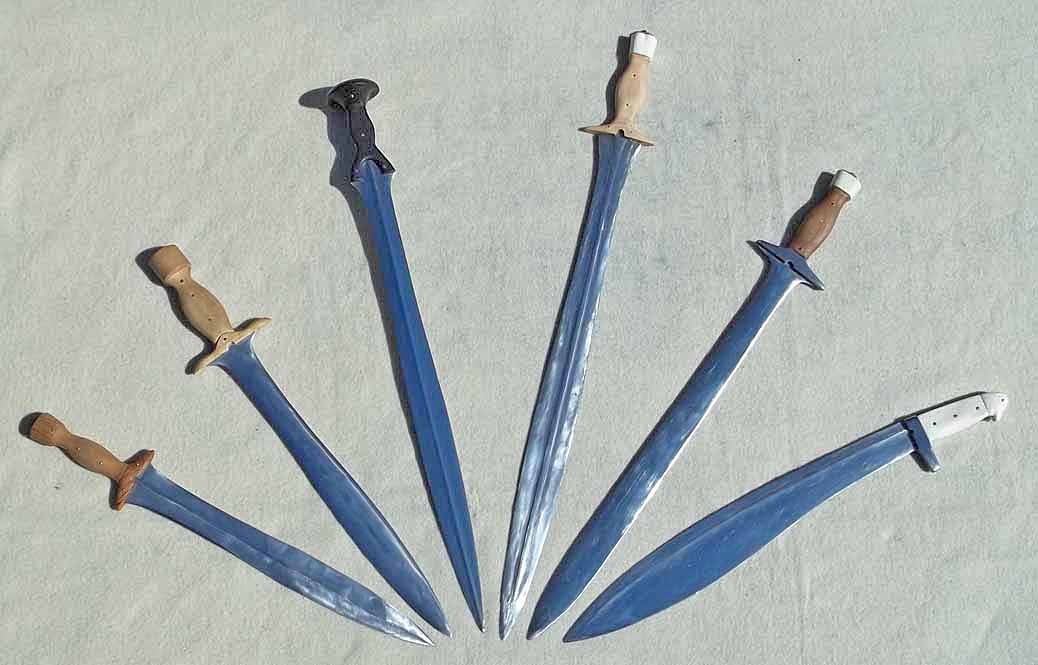
is 8 ounces with a nice midrib. If you are looking for an off-the-shelf Greek sword which is GOOD right out of the box, these are the ones. If they are not yet available through www.deepeeka.in or one of the usual vendors, have patience! |
 |
Fabrica Romanorum--Matt Lukes
Manning Imperial--Craig Stitch, http://www.manningimperial.com
| Hoplite Home Page |
Clothing | Helmets | Photos | Other Greeks,
and Others |
| Shield--Aspis/Hoplon | Armor | Weapons |
Bibliography | The BRONZE AGE |