

CIVILIAN CLOTHING 3/17/11
In general, civilian clothing
and
accoutrements must adhere to the same standards as for military
gear.
Fabric should be 100% linen or wool, or cotton or silk with prior
approval.
Any exposed stitching should be done by hand. The following
descriptions
are very rudimentary, and you are strongly urged to DO SOME RESEARCH,
especially
on decoration and jewelry, before making your clothing. The
best books to consult are Roman Clothing and Fashion by A.T.
Croom,
and The World of Roman Costume by Judith Lynn Sebesta and
Larissa
Bonfante (see the Bibliography
).
This page has been sadly
neglected, but I am attempting to remedy that! Yes, we definitely
need more clear photos of garments and details. Sorry,
sorry... But remember that we veterans are happy to loan books
and expertise. And we are more than happy to loan clothing to new
members!
WOMEN'S CLOTHING
|
|
|
|
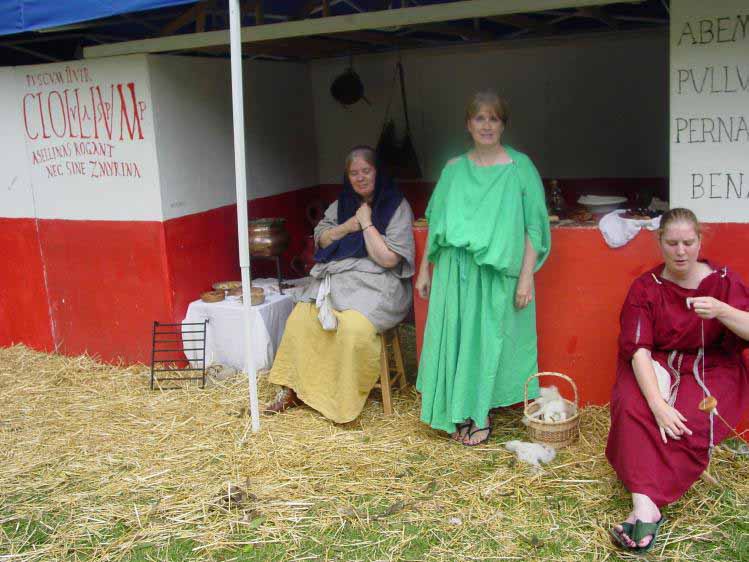
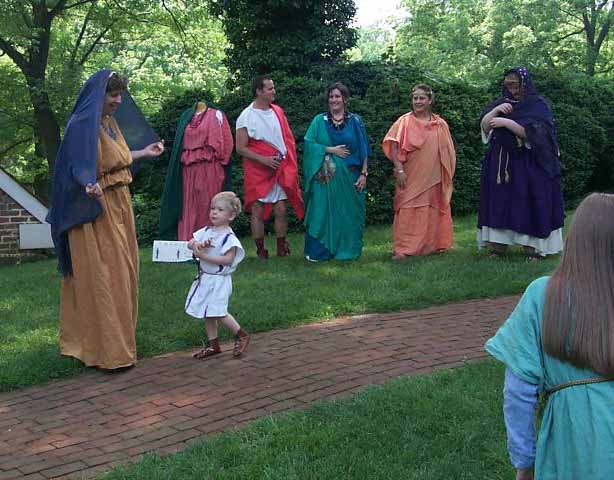
The TUNICA is the basic women's garment, made from two panels of linen or fine wool at least 30 to 40 inches wide--generally from elbow to elbow--and reaching to the ankles when belted. In its traditional form it is sleeveless, and the top edges are not sewn together but rather fastened every few inches by little knots of fabric or possibly small buttons of some sort, leading to the modern term "gap-sleeved" tunic. The fabric is gathered in at these points, and apparently normal brooches or fibulae were not used as fasteners. The knots sometimes look like they are held by thread wrapped around the base, and in other depictions seem to be more disc-shaped. If they are buttons, they are not used with buttonholes since the front and back panels of the tunic touch at the fastenings but do not overlap. From three to five fastening points on each side seems to be common, with as many as seven. Nearly any appropriate color of fabric may be used, and there may be a wide band of a different color at the hem.
There was also a much simpler form of tunica, very similar to a man's tunica, being sewn up the sides and along the top, and having short sleeves (six to eight inches long). It can be worn belted or unbelted. This was most often seen on lower-class or merchant-class women, freedwomen, slaves, and young girls. Like the gap-sleeved tunica it may be any reasonable color, and may have a contrasting band at the hem. Alternatively, it may have clavi, a pair of narrow vertical stripes front and back which reach from the top to the hem. The clavi are about an inch or so wide, and can be from 10 to 20 inches apart (typically equidistant from each other and the sides of the tunica, but not always). They were probably woven into the fabric originally (and most likely ran across the grain of the fabric since the selvege edges were used to form the top edge and hem), but may be sewn on for our purposes.
The STOLA is the traditional distinctive garment of a married Roman woman or matron, worn over a gap-sleeved tunica. At the top, the fabric is gathered into a pair of straps or narrow bands which go over the shoulders, causing the neck opening to form a V-shape--it appears that the neck opening is simply a vertical slit, rather than horizontal. This is just one theory out of several, however! The strap over each shoulder could be a loop of cord, with the top corner of the body panel pulled through one end of the loop, folded over, and sewn in place. Or the fabric itself might simply be gathered on either side of the vertical neck slit, fixed at the center by a narrow band wrapped around. The stola was properly long enough to cover the feet, and it is worn with a belt high under the bust. By the first century AD, the stola is apparently falling out of everyday use, though it is still perfectly acceptable for our uses, and was probably quite common at formal or ceremonial occasions.
An undertunic, probably
sleeveless,
can be worn with the short-sleeved tunica, but not with the gap-sleeved
tunica. It can be seen at the neck, and would presumably be white
linen.
 |
The PALLA (left) is a
large rectangular
wrap, at least 5' by 9'. It is roughly the female equivalent to a
man's toga, but was always worn by a decent woman in public, and could
be put on in a number of ways. Various wraps or cloaks were
also worn, but like the palla these were draped or wrapped but not
pinned. (Photo copyright Jane Walker.) The STROPHIUM is the
Roman brassiere.
It is a band of soft linen or wool 6" to 8" wide (or a folded wider
strip),
long
enough to go around the body a number of times (six or seven for best
results).
It can be worn in several ways, for example placing the center of the
band
at the back and crossing the ends in front to support the breasts, then
wrapping the ends around and tucking them in at the back again.
Evidence
is scarce, however, and pins or ties may have been used. HAIRSTYLES were amazingly varied. While upper-class women favored elaborate arrangements of curls and tiers, simpler hairdos involved coiled braids or a bun at the back. Wigs were used, and those made with red or blond hair were desirably exotic. Traditionally, girls and women tied their hair back with thin woolen bands called vittae, which were considered spiritual protection. Mature Roman women would always cover their heads with a veil or part of the palla when out in public. |
For women participating with
Legio XX, there is also the option of Celtic, British, or Germanic
clothing. Here we have a few excellent sources from bog finds,
plus artwork and Roman descriptions. While the basic garment is
still a simple tunic reaching to the feet, there is also the peplos,
basically a very large tube of fabric with the top section folded down
almost to the waist. The dress is pinned at the shoulders with a
pair of fibulae, and belted at the waist. At least one bog find
consists of a woolen skirt apparently worn over a linen tunic or shirt
(which did not survive).
One major difference from Roman
clothing is that provincials used a lot of patterned fabrics.
Stripes, checks, and plaids were all common, though reenactors tend to
over-emphasize this. Solid colors were common as well! Try
to avoid modern Scottish clan tartans, which were not invented until
the 19th century. Narrow tablet-woven woolen strips were used as
borders or belts. Edges or hems, especially on cloaks, can
be fringed, either by simply unravelling the edge of the fabric, or by
unravelling a separate strip of fabric and sewing it on, or by creating
a fringe by sewing yarn into the edge of the fabric.
Over the tunic or dress is
often a cloak, either rectangular and woolen, or a trapezoid made of
hide (goat, sheep, deer, cow, etc.). The furry side can be worn
in or out, depending on need. The feet can be wrapped in squares
of linen or wool, or even fur, or fabric socks can be made, reaching
anywhere from ankle to knee.
As stated above, put a little
thought and research into your clothing in order to get the look that
matches the portrayal you want. A proper matron in Rome
would not dress like the wife of a soldier in Britain, though in
between those two extremes there may be quite a bit of overlap or
mixing possible.
Roman underwear, or "A wool bra? Are you NUTS?"
http://redsbragbook.livejournal.com/5815.html
Legio VI Victrix (Germany) Civilian Life gallery
http://www.roemercohorte.de/index.php?id=61&serie=5&l=en#bilder
Roman Clothing: Women--Not a terrific page, but has some
basic drawings.
http://www.vroma.org/~bmcmanus/clothing2.html
Archaeological Sewing
http://heatherrosejones.com/archaeologicalsewing/index.html
The Kelticos discussion
board is THE place for information on Celtic and Germanic clothing,
etc. There you will find information drawn from Roman sources as
well.
http://www.kelticos.org/forum/index.php
Gallic women's clothing
http://www.kelticos.org/forum/viewtopic.php?f=18&t=765
Iron Age dress from Loenne Hede, Denmark
http://www.kelticos.org/forum/viewtopic.php?f=18&t=961
Female dress in La Tene B1 in Switzerland
http://www.kelticos.org/forum/viewtopic.php?f=18&t=1086
Textiles and clothing from Les Martres de Veyre, France
http://www.kelticos.org/forum/viewtopic.php?f=18&t=1023
Undergarments
http://www.kelticos.org/forum/viewtopic.php?f=18&t=1149
Compiled Kelticos points on clothing
http://www.kelticos.org/forum/viewtopic.php?f=18&t=1270
Another Tablet Weaving Question (includes excellent info on colors)
http://www.kelticos.org/forum/viewtopic.php?f=18&t=1258
The Romano-Gaulish Woman's Garments from Les Martres de Veyre: A
Possible Reconstruction
http://www.rentapeasant.co.uk/romanogaulish.html
Huldremose clothing
http://oldtiden.natmus.dk/udstillingen/aeldre_jernalder/kvinden_fra_huldremose/huldremosekvindens_dragt/
Basic men's clothing is very simple, consisting of the tunic(s) and footwear, usually with a cloak or wrap of some sort for respectable wear.
| The civilian TUNIC is identical to the military one, but can be any reasonable color. The most common style seems to have been sleeveless with a slit neck opening. Senators wore a white tunic with 2 broad (3" wide) vertical purple stripes (clavi), running from shoulder (at the end of the neck slit) to hem, front and back. Equestrians were permitted to wear narrow (1") purple clavi. These stripes are also seen on tunics of common people or even slaves, in colors other than purple on white. The tunic is worn with a narrow cloth or leather belt so that it just covers the knee. Remember not to skimp on the fabric--make it big and baggy. |  |
Thorsbjerg Cloak
http://www.kelticos.org/forum/viewtopic.php?f=18&t=1178
The SUBLIGACULUM is a loincloth worn as underwear. It can be a simple breechclout, a strip of cloth c. 6" to 12" wide passing under the crotch and hung over a belt at front and back, or it could be a rectangle with ties at the corners. The latter style may also be called a perizoma. Gladiators are seen wearing something like trunks or shorts with an apron-like effect at the front. How common any form of underwear might have been is unknown.
| The TOGA is a formal
garment worn
only by citizens. The toga is normally fine white wool, and will
have to be made of several pieces, all sewn together by hand.
(Selvege
edges can be overlapped and sewn with a blanket stitch or 2 rows of
running
stitch.) The toga praetexta has a purple border (c.3") along the
curved edge, and is worn by magistrates in public office, and also by
citizen
boys and girls under the age of adulthood. Apparently the toga
was
also seen on prostitutes and adulteresses. The toga pulla is made
of dark wool and is worn for mourning. The toga should be
worn
with an unbelted white or off-white tunic, with clavi if appropriate,
and
closed shoes--open sandals were considered improper with a toga.
In the Republic the toga was roughly semi-circular, c. 12 feet long by 6 feet wide, but by the Empire it had become even larger. Its exact shape is not known, but it may have been a sort of ellipse roughly 10 feet wide and 15 feet long or more (see below). It is folded lengthwise into the traditional semi-circular shape before putting it on. With the straight or folded edge upwards, it is held across the wearer's back, and one end is draped over the left shoulder so that it hangs down in front to about mid-shin. The rest of the toga is passed under the right arm and back up over the left shoulder, and the pleats and folds neatly arranged. The Imperial toga can be partly unfolded under the right arm, and at the front part of it can be pulled out from underneath to form a pocket called the "sinus". Generally the left hand must be held in place as shown, even gripping the diagonal edge of the toga, or it will fall off the shoulder. The right hand is free to gesture. |
 |

Like women, civilian men in
Legio XX have the option of portraying provincials. See the pages
on Celts and Cold-Weather
Clothing for clothing guidance, and remember that Roman and
non-Roman clothing may be mixed, depending on your impression.
FOOTWEAR
There was a wide variety of shoes and sandals for men and women. Most were constructed like military caligae, with a one-piece upper nailed between layers of the sole. Many had large open-work areas made by cutting or punching circles, triangles, squares, ovals, etc., in rows or grid-like patterns. Others were more enclosed, having only holes for the laces. Some very dainty women's and children's shoes still had thick nailed soles.
Some shoes had a one- or two-piece upper of soft leather which enclosed the foot like a modern shoe. The edges were nailed between the sole layers. Traditionally, those worn by patricians, senators, and magistrates were called calcei, while common people wore perones. But there is much confusion in terminology and most shoes which have nailed soles and are not caligae or sandals are referred to as calcei. "Calcei senatorii" had soft leather uppers and were secured by wide straps which passed under the foot and crisscrossed up the lower leg. They were red with small ivory crescents attached. Equestrians are shown wearing an identical style, but apparently black in color.
One-piece shoes called
carbatinae
were shaped like caligae/calcei, but had no outer or inner soles
added.
Sandals were generally called soleae, and had nailed or stitched
soles.
It is possible that heavy nailed shoes were for outdoor wear, while
lighter
sandals and carbatinae were worn "around the house". (Also see Leatherworking
Tips.)
Besides open-work on the leather,
shoes and sandals could be dyed, tooled, embossed, or even have gilded
designs.
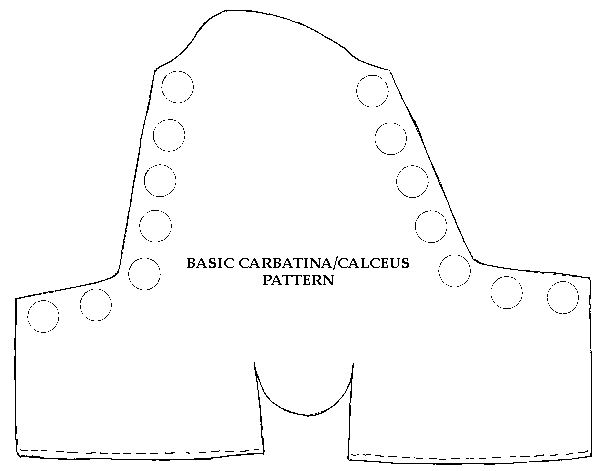 |
Click on this image for a basic pattern for a carbatina or calceus. It's not full-size, sorry, but if it were your printer would probably shrink it anyway. Enlarge it to your size on a photocopier. The lacing holes can be large as shown, or just large enough for the laces. |
 |
Some options for the above basic pattern, taken from surviving originals. Solid areas can also be decorated with cut or punched patterns as described in the text. |
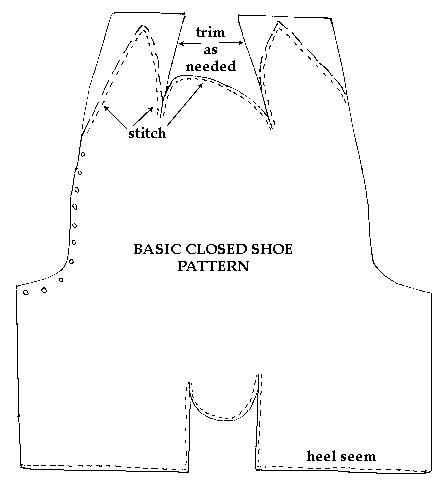 |
Click on this image for the pattern for a closed shoe or calceus. Again, it will need to be enlarged to your size, and some careful experiments with scrap leather or heavy cloth will be necessary for a good fit. |
 |
Reconstructed carbatina, dyed red. |
Socks (udones) were sewn of woven cloth, and could be worn for warmth or as decorative items. In the latter case they would be brightly colored so as to show through the ornate open-work of the shoes, and might leave the toes and heel exposed. Socks worn strictly for warmth were more likely fully closed and not necessarily so colorful (see Cold-Weather Clothing page). A child's sock made of woven wool was found at Vindolanda, http://vindolanda.csad.ox.ac.uk:8080/exhibition/people-2.shtml#sock. Fancy shoes could also have a colorful cloth lining, eliminating the need for socks.
Jared Fleury's page on calcei, http://www.florentius.com/calcei-main.htm
Most reeenactors make their own civilian clothing, or have it made "in house" by fellow members. Being mostly large rectangles, it is just too easy! However, for those who want to purchase, La Wren's Nest is a good source.
Do NOT buy ANY clothing from Museum Replicas/Windlass! It is all hideously inaccurate. See the page of Things to Avoid.